
Sold Your Property? Smart Property Investment Alternatives Australians Actually Use in 2026
What to do with $200k–$1m in sale proceeds when you’re done with tenants, toilets, and tying up capital in one house. In Australia, there are at least eight solid property investment alternatives worth knowing about.
You know that feeling when you hand over the keys and the settlement lands in your account? It’s a great Friday. I had a client, Mark, 58, Ivanhoe business owner, call me the same day. “Ben, I’ve got $650k sitting there and I am not buying another investment property.” Smart man. Because in 2026, with the RBA cash rate still elevated at 3.85%, borrowing to buy again is expensive. And frankly, after years of tenants and maintenance calls, why would you?
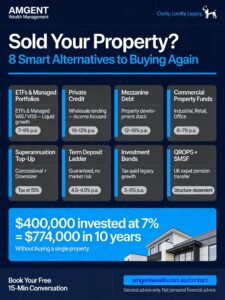
Here’s the thing. When we talk property investment alternatives. Most people think “property or shares.” Full stop. But there are at least eight solid property investment alternatives worth knowing about and several of them pay better income than residential property ever did, without the headaches. Let’s walk through them with real 2026 numbers.
What is a Good Investment Other Than Property in Australia?
The short answer: quite a few things, depending on whether you want income now, growth later, or a tax win first.
The longer answer depends on your chunk of cash. Most sellers I talk to are working with $200k to $800k. At those sizes, you’ve got serious options that retail investors with $10k simply can’t access.
Quick return of 3 property investment alternatives examples for 2026:
- $100k at 4.93% term deposit (Heartland Bank) = $4,930/year. Not retire-forever money, but guaranteed.
- $400k in a diversified ETF portfolio averaging 7–9% = $28k–$36k/year long-term average.
- $400k in a private credit fund = $44k–$48k/year at current 10–12% returns.
Can you live off $100k interest in Australia? Honestly, no. You need closer to $1m for $40k/year using the 4% rule. But $400k+ in sale proceeds? Now we’re talking. Let’s go asset class by asset class.
ETFs and Managed Portfolios, The Boring Backbone
Start here. VAS (ASX300) and VGS (global shares) are the workhorses of any post-property alternative investment portfolio. The long-term ASX200 average sits just shy of 10% including dividends. VHY (high yield ETF) pumps around 5% in dividends alone, quarterly, no tenants required.
For income-focused sellers, a 60/40 split, growth ETFs plus dividend ETFs delivers around 5–7% combined. On $500k, that’s $25k–$35k/year. Not flashy. Compound it 10 years? That $500k becomes $985k at 7%.
Use ASIC’s Moneysmart investment calculator to model your exact numbers in under five minutes. For a deeper dive on building a retirement income portfolio from share and ETFs, see our guide on building a retirement income portfolio in Australia
Private Credit, The Property Investment Alternative Most People Haven’t Heard Of
This is the conversation I’m having more and more with client’s post-property sale. And for good reason.
Private credit is lending to businesses and real estate developers outside the traditional banking system. You’re the lender. You rank ahead of equity holders. You get paid quarterly or monthly. And in Australia right now, returns are sitting at 10–12% p.a.
The Australian private credit market hit $225 billion in 2025, growing 9%, driven by family offices, high-net-worth individuals, and super funds all piling in. Structural tailwinds are real: banks have retreated from certain lending, leaving a gap that private credit fills.
What to know before you invest in private credit:
- Floating rate structures mean returns rise if the RBA hikes again.
- Usually wholesale investor minimum ($500k+), better suited to larger sale proceeds.
- Less liquid than ETFs, typically 3–5 year lock-ups.
- Morningstar flagged credit quality risks in 2026, so manager selection matters.
- ASIC has toughened oversight on the sector, a positive for quality managers.
Client example: Sarah, 62, downsizer. Allocated 20% of $800k proceeds ($160k) into a private credit fund via a wholesale manager. Returning 10.5% = $16,800/year. Sits alongside her ETF portfolio. Diversified across asset classes, not just property.
Mezzanine Debt, Higher Yield, Higher Risk, Worth Understanding
Think of mezzanine debt as private credit’s edgier cousin. It sits in the capital stack between senior debt and equity in property development deals. The senior lender takes first mortgage at 65% LVR. The mezzanine lender bridges the gap to ~80% LVR.
Why does it pay more? Because you’re subordinate to senior debt. If a development goes sideways, senior gets paid first. You’re higher up the risk curve.
Current returns: 12–20% per annum in Australia. Some deals include equity kickers, profit share if the project performs well.
Real example:
A Sydney developer needed 15% extra LVR on a mid-rise apartment project. Senior lender capped at 60%. Mezzanine filled the gap. Investor earned 14% fixed for 18 months. No toilet calls. No vacancies.
Who mezzanine debt suits:
- Sellers with $500k+ in proceeds and wholesale investor status.
- Those who want yield above private credit with manageable exposure.
- Not your whole proceeds, consider 10–15% as a yield booster within a diversified mix.
- Due diligence on the developer and fund manager is non-negotiable.
Established managers like Goldfields Property Development offer structured mezzanine debt funds with institutional-grade underwriting.
Commercial Property Funds, Property Exposure Without the Landlord Hassle
You sold a residential property. That doesn’t mean you’re done with property entirely. Commercial property funds give you exposure to industrial sheds, office buildings, and neighborhood retail, without owning a single brick directly.
And the 2026 numbers are genuinely compelling. After a tough 2023, the commercial market has found its footing.
| Sector | 2025/26 Income Yield | Growth Outlook |
|---|---|---|
| Industrial & Logistics | 6.0–6.5% | Strong (e-commerce tailwinds) |
| Retail (neighborhood) | 5.5–6.0% | Moderate, improving |
| Prime Office | ~7% | Stabilising, income returns up |
Listed REITs like Dexus (ASX: DXS) or Charter Hall are accessible from $500. Unlisted funds typically need $50k–$100k minimum but offer smoother valuations and less daily volatility. Either way, professional management, diversified tenants, no Saturday maintenance calls.
Superannuation, The Tax Win You Can’t Ignore
If I had a dollar for every client who hadn’t maxed their super contributions before selling a property… this one is genuinely the most underused lever available.
FY26 contribution limits:
- Concessional (pre-tax): $30,000/year, taxed at just 15% vs up to 47% marginal rate
- Non-concessional (post-tax): $120,000/year, or $360,000 over 3 years using bring-forward rules
- Downsizer contribution: If you’re 55+ selling your primary residence, up to $300,000 per person ($600,000 per couple) directly into super, completely outside normal caps
Mark’s example: $300k non-concessional into super, growing at 7% (tax-free in pension phase post-60). That’s $421k in five years, generating tax-free income from age 60. His accountant nearly cried happy tears.
Read more at the ATO’s super contributions guide. We cover the new higher balance tax and how it impacts these strategies in out Division 296 super tax explainer.
How $5k Becomes $1 Million, The Silent Millionaire Approach
People love asking: “How do I turn $5k into $1m quickly?” Quickly? You don’t. Reliably? Compounding does it.
$5k at 10% for 47 years. Add $200/month and you’re there in 35. The “silent millionaire” isn’t flashy, they just don’t stop investing.
The 4% rule in plain English: A $1m portfolio can sustainably pay ~$40,000/year indefinitely. That’s golf, gym membership, family holidays, and school fees. Not lavish, but free.
Selling property in your 50s? You don’t need 47 years, you need bigger starting numbers. Which is exactly what a property sale gives you.
Simple compounding projections:
| Starting Amount | Annual Return | Monthly Add | 10 Years | 20 Years |
|---|---|---|---|---|
| $200,000 | 7% (ETFs) | $0 | $393,000 | $774,000 |
| $400,000 | 7% (ETFs) | $500 | $706,000 | $1,560,000 |
| $800,000 | 8% (blended) | $1,000 | $1,800,000 | $4,100,000 |
Projections are illustrative only. Past performance is not a reliable indicator of future returns. Does not account for tax or fees.
Practical Property Investment Alternatives in Australia by Situation
| Your Situation | Best Alternative | Est. Return p.a. | Why It Fits |
|---|---|---|---|
| Debt-free, growth focus | VAS/VGS ETFs | 7–9% | Liquid, low fee, dividend income |
| Income needed now | Private credit fund | 10–12% | Monthly/quarterly income, above-market yield |
| Yield boost (wholesale eligible) | Mezzanine debt | 12–18% | Higher yield, 10–15% allocation max |
| Property exposure, no landlord | Commercial property fund | 6–7% | Industrial/retail/office income, managed |
| Retiring within 5 years | Super top-up + downsizer | 7% tax-advantaged | Tax at 15%, tax-free post-60 |
| Capital preservation | Term deposit ladder | 4.5–4.9% | Guaranteed, no market risk |
| Legacy / kids | Investment bond | 5–6% | Tax-paid growth, gifting tool |
| UK expat proceeds | QROPS + SMSF blend | Structure-dependent | Cross-border compliant, pension transfer |
Not sure which row fits you?
If you’re sitting on $400k–$800k after selling a property, I’ll run the numbers and show you what that looks like in plain English.
Real Client Property Investment Alternatives Case Studies
Mark, 58 – Ivanhoe Business Owner
Sold investment property mid rate-hike cycle. $650k proceeds. Too concentrated in property already.
- Cleared $150k in business debt
- $300k non-concessional into super (bring-forward)
- $200k into VAS/VGS ETFs
Blended 7% return: $500k working capital projected to $700k in five years. He golfs more. Stresses less.
Sarah, 62 – Downsizer, Inner Melbourne
Freed $800k selling the family home. Moved to a smaller place. Didn’t want another investment property.
- $160k private credit fund — 10.5% yield = $16,800/year income
- $300k downsizer contribution into super
- $340k split across Health Care commercial property and term deposits
Combined income: ~$38k/year pre-tax. Pair with part-pension: comfortable, with capital still growing.
Andrew – UK Expat, Selling British Buy-to-Let
British buy-to-let sold. £180k proceeds hit Australian bank account. Unsure what to do when looking at property investment alternatives, concerned about tax traps.
- QROPS pension transfer integrated with Australian super
- Proceeds into managed ETF portfolio
- $15,000 extra annual income from combined structures
“Clarity I couldn’t find anywhere else.” — Andrew’s words, not ours. We unpack more UK expat property investment alternatives in our detailed UK QROPS and pension transfer guide
Honest Talk on Property Investment Alternative Risks
No investment is risk-free. Shares dip 20% in a bad year. Private credit locks up capital for years. Mezzanine loses money if a developer collapses. Commercial property suffers vacancy spikes.
But here’s the comparison: residential property is illiquid, concentrated in one asset, subject to land tax and council rates, and entirely dependent on one tenant paying rent. A bad year wipes your yield entirely.
The answer isn’t avoiding risk. It’s spreading it intelligently. A blended property investment alternative portfolio across ETFs, private credit, commercial funds, and super isn’t “playing it safe.” It’s grown-up investing, the kind that’s still working 20 years from now.
Your Next Move, One Conversation Changes Everything
If you’ve just settled, or you’re about to and those proceeds are sitting in your offset feeling heavy, this is exactly the conversation I have with clients every week.
Why am I, Ben Waite qualitied to talk about property investment alternatives? I’ve sat in trading rooms through the Enron collapse, navigated the GFC at Australia’s biggest super funds, built careers at NAB, Mercer, and RSM, and now I’m here in Ivanhoe helping people like you turn a property sale into lasting, income-generating wealth.
No jargon. No pressure. Just clarity.
👉 Book your free 15-minute conversation at amgentwealth.com.au/contact
Or ask us about the Post-Sale Wealth Checklist — a one-pager that maps your options in under 60 seconds.
Your sale was the hard work. Putting it to work to find property investment alternatives properly? That’s ours.
Frequently Asked Questions: Property Investment Alternatives
Great alternatives to property include diversified share portfolios, ETFs, managed funds, superannuation top-ups, investment bonds, and private credit. Each offers different risk and return profiles. For most Australians selling residential property, a mix of growth-oriented ETFs plus a super top-up is a strong starting point, without the headaches of tenants, rates, and land tax.
Beyond property, Australians commonly invest in Australian and global share ETFs, term deposits, managed accounts, infrastructure funds, and super. If you’re looking for income, a diversified dividend portfolio or high-interest cash account can work well. If it’s long-term growth you’re after, a low-cost index fund is hard to beat over a 10–20 year horizon.
With $1,000, a low-cost ETF (like a broad Australian or global index fund) is a solid first step. You could also make a voluntary super contribution and claim a tax deduction, which effectively boosts your return from day one. The key is starting, compound growth rewards those who get in early, not those who wait for the “perfect” moment.
To generate $3,000/month ($36,000/year) from investments, you’d need a portfolio of roughly $600,000–$900,000 depending on your return rate. At a conservative 4–5% annual yield (think diversified income portfolio or dividend ETFs), you’re looking at around $720,000–$900,000 invested. At a higher growth rate of 6–7%, you could achieve this with closer to $550,000–$600,000, though growth portfolios can be more volatile year to year.
Not comfortably on its own. At 5% per year, $100,000 generates around $5,000 annually before tax — that’s about $417/month. It can be a useful supplement, but it’s not a standalone income. If you’ve recently sold a property and have a larger lump sum, even $400,000–$500,000 starts to become meaningful when invested properly across a mix of income and growth assets.
At a 5% return, $400,000 generates around $20,000/year, tight, but possible as a supplement to other income or a part-pension. At 7%, that’s $28,000/year. Most financial planners would suggest $400,000 is a good base to build from, especially when combined with super drawdowns or part-time work in early retirement. The key is making sure the property investment alternative portfolio keeps pace with inflation over time.
It depends on where it’s invested, property investment alternatives such as a term deposit at ~4.5% returns roughly $22,500/year. A diversified share portfolio averaging 7–8% could return $35,000–$40,000, though that includes both income and capital growth, and it can fluctuate. A managed income portfolio targeting 6% would net around $30,000/year. Your tax situation and drawdown strategy also affect what you actually take home.
In Australia, a $1,000,000 lifetime annuity for a 65-year-old might pay roughly $4,500–$5,500/month depending on the provider, age, and features chosen (e.g. indexed vs flat, reversionary for a partner). Annuities offer certainty but give up flexibility — most advisers recommend using them for a portion of your portfolio rather than all of it. It’s worth getting a comparison from a licensed adviser before committing.
With $5,000, you’ve got decent options for property investment alternatives: a broad-market ETF via a low-cost broker (CommSec Pocket, Stake, etc.), a voluntary super contribution, or adding to an existing managed fund. If you have high-interest debt, knocking that off first is arguably the best guaranteed “return” you’ll get. If your super is lagging, a non-concessional contribution is a tax-effective option worth exploring with your adviser.
Honestly? There’s no reliable “quick” path from $10k to $100k without taking on serious risk. The legitimate route is time and compounding — at 10% annually, $10,000 becomes ~$100,000 in about 24 years. If you’re selling a property and have more like $200,000–$500,000 to invest, the timeline shrinks significantly. Anyone promising fast 10x returns without mentioning risk should set off alarm bells.
The Rule of 72 is your friend here: divide 72 by your annual return rate to estimate doubling time. At 7%, $10,000 doubles in roughly 10 years. At 10%, about 7 years. “Quickly” is relative — anything promising to double your money in months is almost certainly high-risk or a scam. A balanced portfolio with a realistic 7–9% long-term return is actually a pretty compelling story when you think in decades, not days.
At a 7% annual return: approximately 34 years. At 10%: about 24 years. At 12%: around 20 years. Regular additional contributions dramatically shorten this — add $200/month to your $10,000 base at 8% and you hit $100,000 in roughly 15 years. The takeaway for property sellers? Starting with a larger lump sum from sale proceeds puts you well ahead of the curve from day one.
The “smartest” move depends on your situation, but for most people: clear any high-interest debt first, then split between a low-cost ETF and a super top-up. If you’re over 50 and have capacity under your concessional cap, putting it into super and claiming a tax deduction is often the highest-return decision you can make. A quick conversation with a financial adviser to map it to your own goals is genuinely worth the time.
Right now in Australia (2026), $10,000 could go into a high-interest savings account (~4.5%), a short-term term deposit (~4.75%), an ETF via a low-cost platform, or a voluntary super contribution. If you’re in the accumulation phase and don’t need the money for 7+ years, a diversified growth ETF is hard to argue against. Need it within 2–3 years? A term deposit or HISA gives you certainty without share market volatility.
The 15×15×15 rule is a compounding concept: invest ₹15,000/month (it originated in India) at 15% per year for 15 years and you’ll accumulate roughly ₹1 crore (~$1M AUD equivalent in the original context). In an Australian context, the principle translates: invest $1,500/month at 10–12% for 20–25 years and you’re looking at a substantial portfolio. It illustrates how consistency beats lump-sum heroics — regular, disciplined investing wins long-term.
Yes, but it takes time. At 10% annually, $5,000 becomes $1 million in about 76 years (not super practical). The more realistic version: start with $5,000, add regular contributions, and let compounding do the work over 30–40 years. If you’re selling a property at 45–55, you’re likely working with a much bigger base than $5,000, which makes $1M a realistic retirement goal within 10–20 years.
For a quick but measured return, a term deposit or high-interest savings account gives you certainty (~4.5–5% in 2026). For a slightly higher potential return with moderate risk, a diversified ETF or managed fund works well even over a 12–18 month period. “Quick” and “high return” rarely go together without taking on meaningful risk — it’s worth being honest about your timeline and what you can afford to lose before chasing yield.
The 4% rule suggests you can withdraw 4% of your portfolio annually in retirement without depleting it over a 30-year period. With $1,000,000 invested, that’s $40,000/year — or about $3,333/month. Combined with the Age Pension (if eligible), that’s a comfortable retirement income for many Australians. It’s a useful rule of thumb, but it assumes a balanced portfolio and doesn’t account for market crashes, inflation spikes, or tax — so always model your own situation with an adviser.
Through time, compounding, and regular top-ups. $5,000 alone won’t do it in a reasonable timeframe — but $5,000 plus $500/month at 9% annual return gets you to $1M in roughly 35 years. Sell a property in your 40s and reinvest the proceeds? You’re working with a much bigger base and a much shorter runway to $1M than you might think.
If you don’t have an emergency fund, start there. Otherwise: a low-cost ETF, a voluntary super contribution (especially if you’re near the concessional cap), or paying down a mortgage offset. Tax-effectiveness matters a lot here — $5,000 into super at a 45% marginal tax rate is effectively a $2,250 government contribution for free. Your marginal rate and timeline should drive the decision.
A silent millionaire is someone who accumulates significant wealth quietly, without flashy lifestyle signals. No Lamborghini, no waterfront mansion — just consistent investing, living below their means, and letting compounding do the work over decades. Many of the wealthiest Australians you’d never pick in a crowd. It’s the “boring is powerful” investment philosophy in a nutshell, and honestly, it’s the most reliable path for most people.
With compounding and time. $5,000 invested at 10% per year grows to roughly $450,000 over 48 years. More practically: start with $5,000, contribute $300/month, and at 8% over 30 years you’ll exceed $400,000. Sell a property and reinvest the proceeds early, and you can hit that number far sooner. It’s not magic, it’s just maths that most people don’t take seriously until it’s too late.
General Advice Disclaimer: The information in this article is general in nature and does not consider your personal financial situation, objectives, or needs. It is not intended as financial advice. Before making any investment decision, you should consult a qualified financial adviser. AMGENT Wealth Management is authorised to provide financial services. Past performance is not a reliable indicator of future returns. Returns mentioned are estimates only and not guaranteed.