High Net Worth investors in Australia are giving more. Legacy is now a must-have, not a “maybe one day” thing.

There’s no need to overcomplicate it. Philanthropy and legacy results all revolve around bespoke structures, family conversations, efficient giving and simple outcomes. Here’s how it works.
Why philanthropy is booming
Australian high-net-worth numbers are surging. In 2024, there were roughly 690,000 HNW individuals, up 8.7% from 2023, collectively holding $3.3 trillion in investable assets. Baby boomers are sitting on $2.6 trillion set to transfer in the next 20 years. That’s a huge slice earmarked for giving or legacy.
More than half of HNW families (54%) plan to leave part of their estate to charities, friends, or educational institutions. It’s not lip service. It reflects growing wealth and a renewed focus on “giving while living,” not just leaving a cheque in a will.
What stops people undertaking philanthropy? Answers (before you ask).
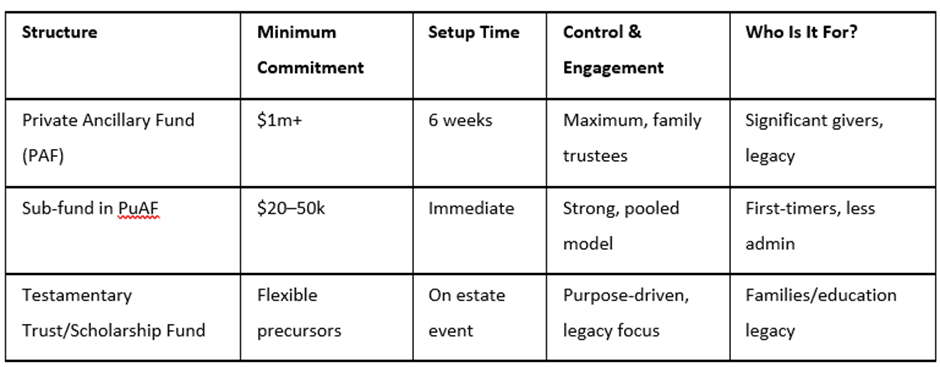
- Concerns about cost? Setting up a sub-fund in a public ancillary fund can be done immediately, with minimums starting at $20,000–$50,000. No setup fee. Private Ancillary Funds need more scale ($1m+) a little more time – about six weeks to establish and will increase your costs ~ $5,000. Yet a PAF is still relatively straightforward if you’re serious.
- Time-poor? Most structures run in the background. Professional administration and governance are built-in. You can be as hands-on or passive as you want.
- Unsure about control or trust? Both private and public ancillary funds will give donors control over investment parameters and choice of beneficiaries. Your adviser sits beside you, not between you and your money.
- Think this only works for Bill Gates types? Absolutely not true. These PAF works for normal families, entrepreneurs, business owners.
Want a real-world client examples:
A 60-year-old woman divorced, used her settlement to launch a $2m family philanthropic fund. Priority: ethical screening (no pokies, no tobacco), and added her adult children as trustees. Now the family legacy is locked in.
Retired tech founder, no kids, sets up a $10m fund. Targeted grants to fight domestic violence and with that managed their tax deductions over the next five years from the funds that were contributed. ATO GUIDANCE HERE:
A simple roadmap to giving back
Identify when triggers occur to act:
Business sale, big inheritance, succession plans, milestone birthdays or retirement, an unusually high-income year or even a personal event (illness, loss, wanting to “give back”) can all be times when we finally look to act.
All you need to do is have a quick conversation with us:
How much do you want to commit? What causes matter to you? Is family involvement key? What level of engagement suits, i.e. annual reviews or more deep involvement?
Matching the structure to your intent:
Private Ancillary Fund (PAF): for $1m+, want total control, family legacy. 5% distribution per year. 100% tax deductible, ACNC/ATO governance.
Sub-fund/Public Ancillary Fund (PuAF): fast setup, as low as $20k–$50k, pooled administration, still full donor input on grants.
Testamentary Trust/Scholarship Fund: cement legacy, educational focus, flexibility with tax outcomes.
Let professionals help:
Strategic advice, accountancy, governance, investment oversight are all required our tip is to use an adviser as a good project manager to make things easier on you.
Real structures for real people
ATO guidance for available structures here
My philanthropy secrets (you won’t find in brochures)
- Use philanthropy to manage lumpy tax years. Large donation this year? Spread deductions over five years. Stay under Div 293 cap, trim your tax whilst you’re doing good.
- Giving through structured funds is income-tax exempt, perpetual, and has clear governance. This approach can outlast most family businesses.
- Want to trial family decision-making before transferring a big inheritance to them? To see how everyone performs try sandboxing their involvement with a sub-fund before the $20M business hands down.
How to talk to your family (or business partners)
Legacy chat: “How should our name be remembered outside the family?”
Milestone trigger: “Is there a cause behind this next chapter?”
Big liquidity: “How will you tell your story, not just spend it?”
The whole process is easier (and cheaper) than you think. At AMGENT we can keep it light, clear, and deliver an outcome the grandkids will brag about. Skip the “philosophy’ and nail the outcome.
Use structured giving to spark better family conversations, lower your tax, and lock in a legacy that actually means something.
Ready? The paperwork’s easy. The impact is permanent.
Book a Strategy meeting.
Ben Waite