
Boutique wealth management · Collingwood, Melbourne
Boutique Financial Adviser in Melbourne: Senior-Led, Coordinated Advice
If you are looking for a boutique financial adviser in Melbourne, you probably want something specific: one senior adviser who knows your whole situation, explains the trade-offs plainly and stays with you as life changes. You do not want to be passed between call centres, junior staff and product specialists. AMGENT Wealth Management is a boutique advisory firm based at 88 Langridge Street, Collingwood. It works with business owners, UK expats, professionals and retirees who need their super, investments, retirement income, insurance, succession and estate decisions handled as one plan.
This guide explains what "boutique" really means, how it differs from bank-aligned and large advice groups, what advice typically costs, and how to check any Melbourne adviser before you sign anything. It also covers the point most firms skip: boutique does not automatically mean independent.

What is a boutique financial adviser?
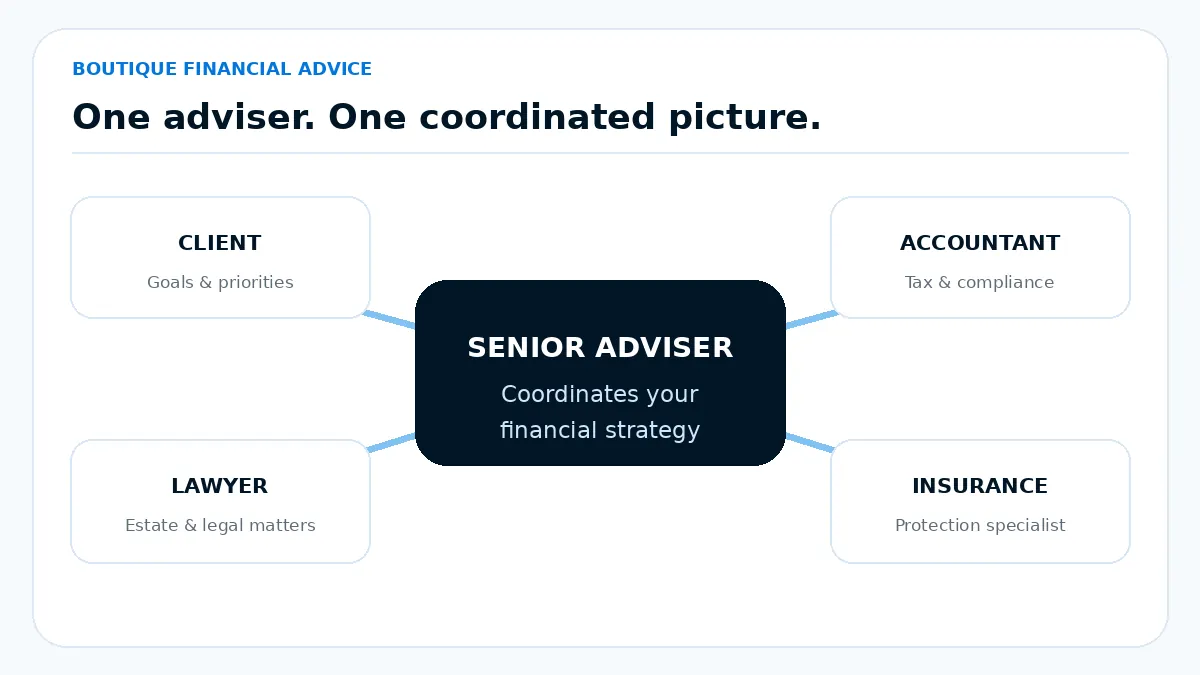
A boutique financial adviser is a small, privately owned advice practice. Clients work directly with a senior adviser rather than a large team or a rotating pool of planners. There is no legal definition of "boutique" in Australia. In practice, the word usually points to four things:
- Direct senior access: the person who gives the advice is the person you speak to.
- Fewer clients per adviser, so there is time to understand context, history and family dynamics.
- Advice scoped around you, not around a product range or a standard service package.
- Coordination with your other professionals, such as your accountant, estate lawyer and insurance specialists.
Boutique advisers vs banks and large advice firms
| Consideration | Boutique adviser | Large or institutionally owned advice group |
|---|---|---|
| Who you deal with | Usually the principal or a senior adviser, directly | Often a team. Your contact may change over time |
| Scope | Built around your decisions and circumstances | Often structured into set service tiers |
| Continuity | Same adviser who knows why earlier decisions were made | Depends on staff turnover and internal structure |
| Coordination | Commonly works alongside your accountant and lawyer | May have in-house specialists, or refer out |
| Scale and resources | Smaller team, so ask about back-up and capacity | Larger research, operations and support teams |
Neither model is right for everyone. Large firms can offer depth of resources. A boutique adviser is usually chosen for continuity, accountability and a personal relationship. When you compare, look past the label and ask how the advice will actually be delivered.
Boutique is not the same as "independent"
Many Melbourne searches use "boutique" and "independent" as if they mean the same thing. They don't. Under section 923A of the Corporations Act 2001, an adviser can only call themselves "independent", "impartial" or "unbiased" if they meet strict conditions. Those conditions include not receiving commissions (such as life insurance commissions) or other conflicted remuneration, and having no product associations that could influence the advice.
AMGENT is open about this. Its current Financial Services Guide states that AMGENT and its adviser cannot describe their advice as independent, impartial or unbiased, because commissions may be received on life insurance products. Every adviser in Australia must still act in your best interests when giving personal advice. The useful question is not "Are you independent?" It is "How are you paid, and what conflicts could apply to my advice?" A good boutique adviser will answer that in writing before you commit.
The benefits of a boutique financial adviser in Melbourne
- One person owns the big picture. AMGENT keeps one senior adviser responsible for your wider position, while accountants, lawyers and other specialists work within their own areas. The aim is fewer gaps, fewer conflicting assumptions and clear ownership of the next decision.
- Context is not lost. Selling a business, moving a UK pension or receiving a TPD payout affects several areas at once. An adviser who remembers why earlier decisions were made can judge how a new decision affects the rest of your plan.
- Plain-English trade-offs. Complex issues are turned into decisions, options and actions you can understand.
- Phased, scoped work. Complex matters can be staged so urgent issues are dealt with first, without losing sight of the wider plan.
- Ongoing stewardship. Your plan can be reviewed as markets, legislation, family circumstances and business priorities change.
Who a boutique adviser suits (and who it may not)
A boutique model tends to suit people whose financial decisions are connected, for example:
- Business owners planning a sale, succession or life after the business
- UK expats weighing UK pension transfer considerations alongside Australian super, tax and estate issues
- High-earning professionals and executives who want strong income turned into deliberate wealth
- Medical professionals balancing practice ownership, cash flow, super and insurance
- Pre-retirees and retirees who need to know what retirement can support before making decisions that are hard to undo
If you only need a simple, single-product transaction, a full advice relationship may be more than you need. A good adviser will tell you that during the first conversation, or refer you elsewhere.
What AMGENT advises on
AMGENT advises across six core areas. The work is scoped around how those areas interact in your circumstances, so they are not sold as separate solutions.
- Wealth and investment management: a clear purpose, risk framework, diversification approach and review process for the capital you have built.
- Retirement and income planning: working out how super, investments, property and business proceeds can fund your spending through retirement.
- Superannuation and SMSF advice: contributions, pension strategies, investment settings, SMSF suitability, liquidity, trustee responsibilities and beneficiary arrangements. Higher balances may also need a view on the Division 296 thresholds, and AMGENT's educational Division 296 estimator can help frame that discussion.
- Business and personal insurance: life, TPD, income protection, key person and ownership risks around the people and cash flow your plan depends on.
- TPD claims advice and support: the financial decisions around a TPD claim, including tax on a TPD payout from super, payout choices and investment planning after payment.
- Estate planning and business succession: linking your legal intentions with ownership, super, insurance, liquidity and the practical transfer of family or business wealth.
Where a decision needs legal, accounting, specialist tax, lending or medical input, AMGENT identifies that need and coordinates with the right professional. It does not present that work as financial advice.
How the advice process works
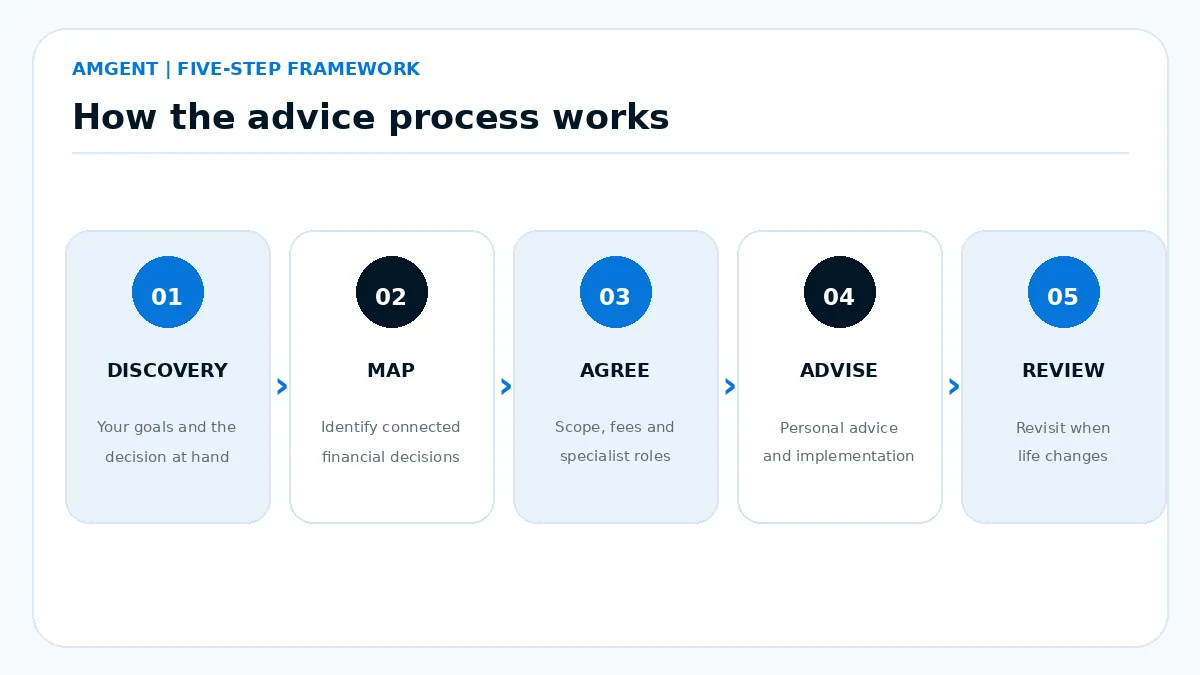
AMGENT uses a five-step advice process with clear ownership at each stage:
- Discovery and fit: a free, confidential conversation about the decision in front of you and the people, assets or business interests it affects.
- Map the dependencies: what else the decision touches, such as super, retirement income, tax, ownership, insurance, estate planning or family cash flow.
- Agree scope, fees and specialist roles: confirming in advance what AMGENT will advise on, the agreed fee basis, and which work sits with your accountant, lawyer or other specialists.
- Develop and implement personal advice: recommendations based on your goals, financial situation and needs, within the areas AMGENT is authorised to advise on, followed by coordinated implementation.
- Review when the facts change: revisiting the plan when your business, family, health, retirement timetable, portfolio or relevant laws change materially.
What does a boutique financial adviser cost in Melbourne?
Fees vary with the scope and complexity of the work, so be wary of any firm that quotes a price before understanding your situation. In general, Australian advisers charge some combination of:
- Initial advice fees to prepare, present and implement a Statement of Advice (SOA)
- Ongoing advice fees for reviews and ongoing service, either a set dollar amount or a percentage of funds under advice
- Hourly or consultation fees for defined pieces of work
- Commissions on some life insurance products, which must be disclosed to you
AMGENT is upfront about its fee ranges. Its current Financial Services Guide (Version 02.26, issued 1 July 2026) sets out the following, including GST:
- Initial advice fees from $3,500 to $22,000
- Ongoing advice fees of up to 1.1% of funds under management, ranging from $5,500 to $55,500 a year
- Hourly rates for other services from $330 to $550 an hour
Your actual fee is agreed with you before any personal advice work begins and is confirmed in your SOA. For current fee disclosures, read AMGENT's Financial Services Guide. For an independent overview of how advice is priced, see ASIC Moneysmart's guide to financial advice costs, and read AMGENT's article Is a Financial Adviser Worth It in Australia?
How to choose a boutique financial adviser in Melbourne: a 7-point checklist
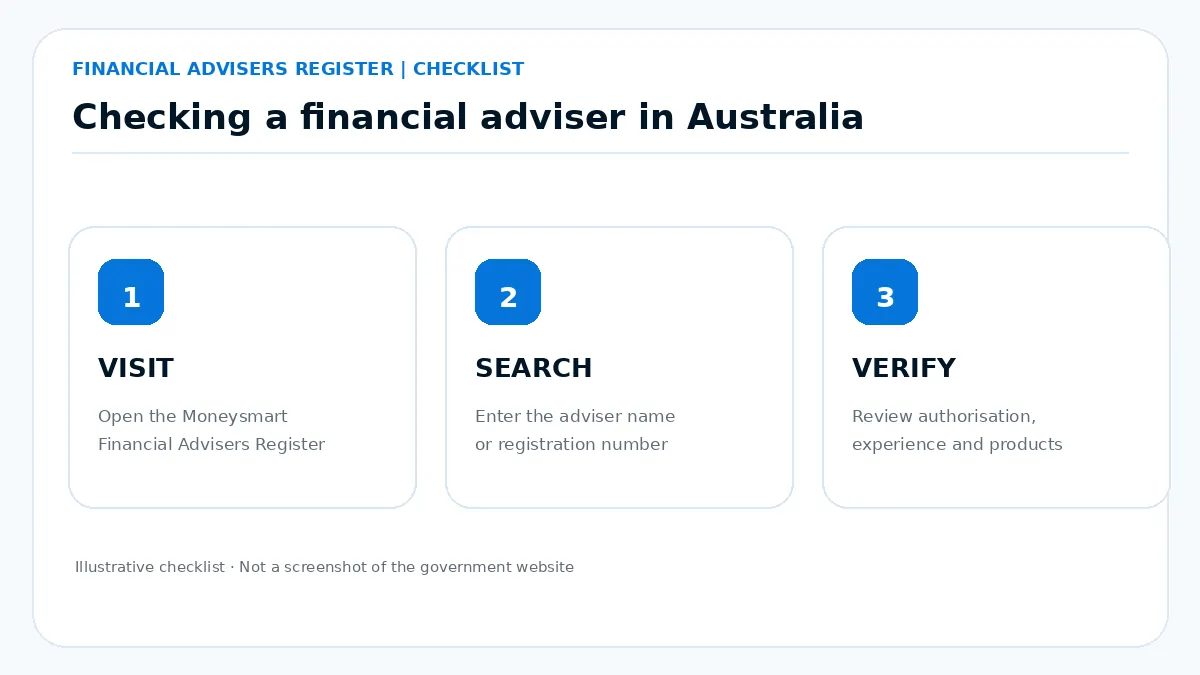
- Check the Financial Advisers Register. Search the adviser's name or number on ASIC Moneysmart's Financial Advisers Register. It shows where they have worked, their qualifications and training, their professional memberships and the products they can advise on. AMGENT's adviser, Benjamin James Russell Waite, is Authorised Representative No. 001004141.
- Confirm the licensee. Every adviser must hold an Australian Financial Services Licence (AFSL) or be authorised by a licensee. Note the AFSL number and check it.
- Read the Financial Services Guide. It explains services, fees, commissions, associations and how complaints are handled, including access to the Australian Financial Complaints Authority (AFCA).
- Ask who will actually advise you, and whether that person stays with you over time.
- Match experience to your problem. Years in the industry matter less than experience with situations like yours, such as a business exit, UK pension transfer, SMSF or TPD claim.
- Get the scope and total dollar cost in writing, including what is excluded and what any ongoing service actually includes.
- Test the communication. After the first meeting, you should understand the reasoning behind any suggestion and know exactly what happens next.
Questions to ask in your first meeting
- What exactly is included in the scope, and what is excluded?
- What will I receive at the end of the advice process?
- What is the total dollar fee, and are there other costs or commissions?
- How do you work with my accountant and lawyer?
- If you recommend ongoing advice, what does it include, and how do I end it?
Red flags
- Product recommendations before your goals and situation are understood
- Promises of returns, or pressure to act quickly
- Reluctance to provide an FSG or explain how the adviser is paid
- Fees quoted as a percentage only, with no dollar figure
For more guidance, see Moneysmart's choosing a financial adviser and AMGENT's guide to choosing a financial adviser in Melbourne.
Local advice in Collingwood, Ivanhoe and online

AMGENT meets clients in person at 88 Langridge Street, Collingwood VIC 3066, close to the CBD and Melbourne's inner north and east. The firm also works with clients in Ivanhoe and surrounding suburbs, with in-person appointments at the Collingwood office. Video meetings are available by appointment for clients elsewhere in Victoria and across Australia. If you live near Ivanhoe, you may also find AMGENT's guide to choosing a financial adviser in Ivanhoe useful.
Why choose AMGENT Wealth Management?

AMGENT was built around one idea: clients should know who is responsible for the whole picture.
Benjamin Waite, Founder & Director, has more than 25 years of experience across domestic and international financial markets, superannuation and financial advice. His career includes time in the United States and Japan, work in London's financial markets, and senior roles with major Australian financial and professional-services organisations. His qualifications are:
- CFP® (Certified Financial Planner®)
- CFTe
- Master of Applied Finance (M App Fin)
- Advanced Diploma of Financial Planning (Adv Dip FP)
- Diploma of Technical Analysis (Dip TA)
- Qualified tax relevant provider (QTRP)
What clients can expect:
- Direct senior adviser access, with Ben keeping the central advice relationship
- One coordinated financial picture across business, super, retirement, protection, estate and cross-border issues
- Coordination with your accountant, lawyer and insurance specialists
- Scope and fees agreed before personal recommendations begin
- Published guides and educational calculators, including a retirement simulator, a TPD tax component estimator and a business exit checklist
Read Ben's story and find AMGENT's Google review QR code on the same page.
Frequently asked questions
What is a boutique financial adviser?
A boutique financial adviser is a small, privately owned advice practice where you work directly with a senior adviser. The focus is on personal service, continuity and advice built around your circumstances rather than a standard product range. "Boutique" is a description of the service model, not a legal category.
Is a boutique financial adviser better than a bank financial planner?
Not automatically. A boutique adviser usually offers more direct senior access and continuity, while a larger organisation may offer more in-house resources. Compare advisers on their experience with situations like yours, the scope of advice, total fees, conflicts of interest and who will advise you over time.
Is a boutique financial adviser the same as an independent financial adviser?
No. In Australia, "independent" is a restricted term under section 923A of the Corporations Act. It can only be used by advisers who, among other conditions, receive no commissions or conflicted remuneration. Many boutique firms, including AMGENT, do not meet that definition and must say so in their Financial Services Guide.
How much does a financial adviser cost in Melbourne?
It depends on the scope and complexity of the advice. AMGENT's current FSG lists initial advice fees of $3,500 to $22,000 and ongoing advice fees of up to 1.1% of funds under management ($5,500 to $55,500 a year), including GST. Your actual fee is agreed before advice work begins.
How do I check if a financial adviser is registered?
Search the adviser's name, number or suburb on the Financial Advisers Register at moneysmart.gov.au. It shows their qualifications, employment history, memberships and the products they are authorised to advise on.
Do I need to meet my adviser in person?
No. AMGENT meets clients at its Collingwood office and also offers video meetings by appointment for clients across Australia.
Can a financial adviser work with my accountant and lawyer?
Yes. AMGENT can coordinate your financial strategy with your existing accounting, legal and other specialist advisers. Each professional remains responsible for advice within their own area.
Talk to a boutique financial adviser in Melbourne
The right boutique financial adviser in Melbourne should give you one clear owner of your strategy, a scope and fee you understand before you commit, and advice that connects your business, super, retirement, insurance and estate decisions. Bring the decision that is creating the most complexity, whether that is a business sale, a UK pension, a retirement date or a TPD claim, and start there.
Email info@amgentwealth.com.au · 88 Langridge Street, Collingwood VIC 3066